

Open Application Model (OAM): A Game-Changer for Deploying Cloud-Native Applications
Simplifying Multi-Cloud Deployments with the Open Application Model
Picture this - you're on a road trip with your friends, excited for the adventures ahead. You've got your destination in mind, a trustworthy car, and a map to guide you. But as you hit the road, you encounter unexpected detours, roadblocks, and challenges - making your journey longer and more complicated than you initially anticipated.
Similarly, in the world of software development, deploying and managing modern applications across different cloud platforms can be complex, with challenges such as vendor lock-in, inconsistent deployment models, and lack of portability. However, the Open Application Model (OAM) has emerged as a powerful tool that simplifies the deployment and management of cloud-native applications, providing a standardized approach for building, deploying, and scaling applications across different cloud platforms.
In this post, we'll explore how OAM can revolutionize application deployment and simplify the process, just like a GPS that helps you navigate through the complexities of modern cloud computing.
What is Open Application Model (OAM)?
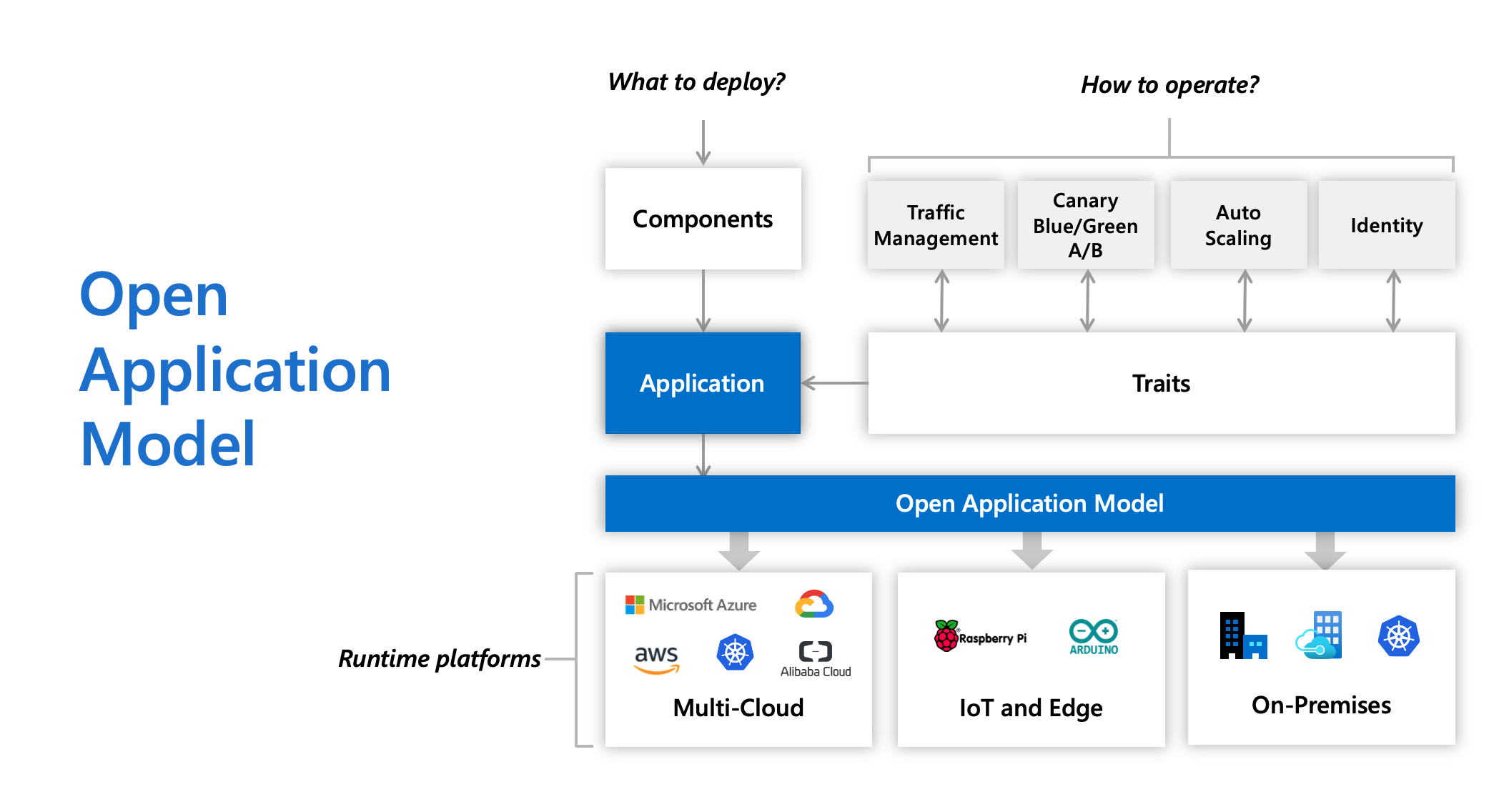
At its core, OAM is an open-source standard offering a declarative model for outlining cloud-native applications, irrespective of any particular platform. It establishes a set of APIs and conventions for characterizing application components, their connections, and the intended behavior of the application. Think of it as a blueprint or a recipe that captures the essential ingredients and instructions for building and deploying applications in a cloud-native environment.
One of the key strengths of OAM is its portability. Just like a GPS that can guide you to multiple destinations using the same map, OAM allows you to describe and deploy applications consistently across different cloud platforms, such as Kubernetes, Alibaba Cloud, Azure, and more. This eliminates vendor lock-in and enables developers to build and deploy applications on their preferred cloud platform without being tied to a specific vendor's proprietary deployment model.
Simplifying Application Deployment with OAM
OAM simplifies application deployment by providing a higher level of abstraction, which separates application components from the underlying infrastructure. It enables developers to express the desired state of an application, including its components, configuration, and relationships, using a declarative model. This declarative approach is akin to using a recipe to bake a cake, where you specify the ingredients, their quantities, and the instructions, and the oven takes care of the rest.
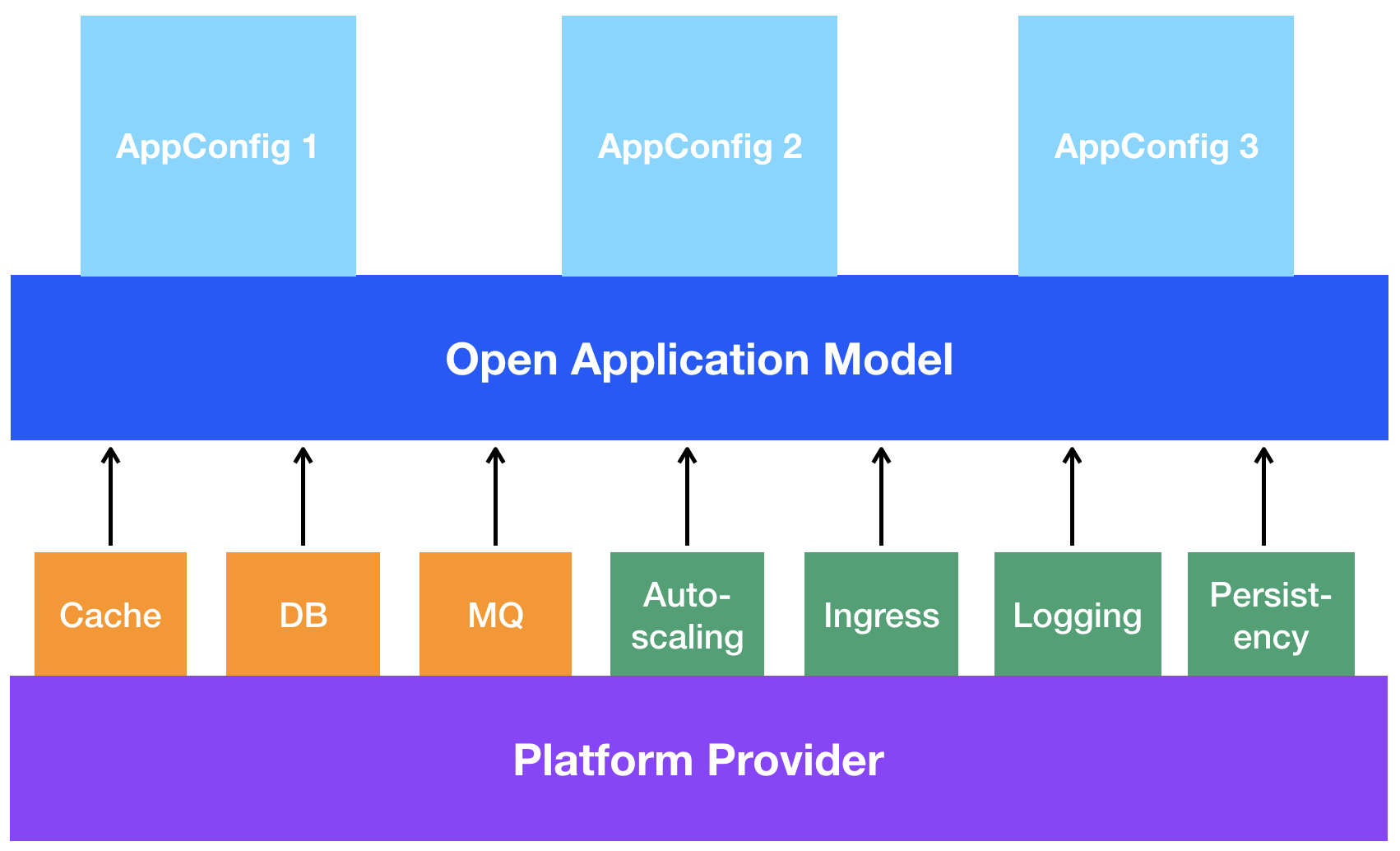
With OAM, developers can define and package applications using application configuration files that capture the essential attributes and behavior of the application. These configuration files can be versioned, shared, and reused, just like a blueprint that can be used to build multiple houses. This enables consistent and repeatable application deployment across different environments, making it easier to manage and scale applications.
Furthermore, OAM provides a clear separation of concerns between the application components and the platform-specific infrastructure. This separation is similar to how a car's GPS handles navigation, while the car itself focuses on providing power and mobility.
OAM allows developers to focus on building the application logic and behavior, while the platform takes care of the operational aspects such as scaling, upgrading, and monitoring.
Enabling Collaboration and Innovation
"Developers think in terms of application architecture, not of infrastructure."
Just like how a GPS allows multiple people to collaborate and navigate together, OAM promotes collaboration and innovation in the world of application development. OAM defines a set of APIs and conventions that enable a clear separation of responsibilities between different stakeholders, such as developers, operators, and platform providers.
Developers can use familiar tools and frameworks to build application components in OAM, without being tied to a specific deployment model. Operators can define policies and rules for deploying and managing applications, such as scaling, monitoring, and rolling upgrades, using platform-specific tools and capabilities. Platform providers can implement and optimize the OAM runtime to provide a consistent experience across different cloud platforms.
Separating responsibilities fosters collaboration and innovation. Developers write code, operators deploy and manage applications, and platform providers optimize infrastructure. This collaborative approach accelerates the development and deployment of modern applications, while also promoting interoperability and portability across different cloud platforms.
Use Case: Cloud Native Application Marketplaces
Cloud Native Application Marketplaces are online marketplaces that allow developers to explore, share, and use reusable application components compatible with OAM. It provides a one-stop solution for developers to find prebuilt components like containers, and microservices, which can be composed together to build an application.
Cloud Native Application Marketplaces provide a very user-friendly interface that allows the user to search for different application components based on various criteria. Once the component is selected, developers can deploy it in their own environments using various OAM-compliant tools and platforms. OAM's portable deployment model ensures that the component can be deployed consistently across different cloud platforms, container runtimes, and orchestrators, providing portability and flexibility in application deployment.
Cloud Native Application Marketplaces can benefit both the developers and the organizations. Developers can improve their productivity by developing applications with a greater speed using the prebuilt components. It also encourages collaboration and knowledge sharing among the developer communities. For organizations, the time to launch a product is significantly decreased while simultaneously reducing the development cost. This also provides consistency and reliability in application deployment and management.
Overall, Cloud Native Application Marketplaces provide a valuable ecosystem for developers to discover, share and use reusable application components, improving efficiency, and reducing time-to-market, while increasing innovations.
Here are some more real-world scenarios where OAM can be used:
Internet of Things (IoT)
As IoT has become a part of our daily life, it can be very much benefitted from OAM. Developers can define reusable components for different IoT devices and compose them into a single application that can be deployed and managed effectively.
Gaming Applications
The gaming industry is rapidly growing at a very fast rate. OAM can bring wonders to it! It can handle various microservices like game servers, matchmaking, and in-game chat services with ease.
These are just a few use cases of OAM. Companies like Alibaba Cloud, Microsoft, Napptive, and Datadog have already adopted the Open Application Model standard in their cloud-native platforms, paving the way for more organizations to leverage the capabilities of OAM in their use cases.
Conclusion
In conclusion, the Open Application Model (OAM) provides a standardized approach for building, deploying, and scaling cloud-native applications across different platforms. Its portability, higher level of abstraction, and clear separation of concerns make it easier for developers to express the desired state of an application, while the platform takes care of the operational aspects.
By promoting collaboration and innovation, OAM enables developers, operators, and platform providers to work together seamlessly, unlocking the full potential of cloud-native applications. Its adoption by companies such as Alibaba Cloud, Microsoft, Napptive, and Datadog further emphasizes its importance in the world of cloud-native application deployment.
Therefore, organizations should embrace the power of OAM and take advantage of its benefits to simplify the deployment and management of their applications, enabling consistent, portable, and collaborative application deployment across different cloud platforms.


